Recently a small team of researchers headed out to the IISD-Experimental Lakes Area to do some winter sampling for the pELAstic project. This work was part of a whole-lake study which is ongoing, looking at the fate and effects of microplastics on a freshwater ecosystem. While northwestern Ontario is typically a winter wonderland this time of year, this winter was much different. The little amount of snow that was covering the ground melted quickly into slush as temperatures rose above 0 C throughout the week. Still, the show must go on and our goals of the week were twofold:
- Collect ice cores to look for microplastics in the ice
- Catch some burbot to see what those guys are eating (gastric lavage)
The first part of the trip was a success! While the temperature outside was heating up, the ice was still thick and core-able (52 cm of ice!). We used an ice corer to drill into the ice and retrieve a core, which was then sectioned into white ice (the top part) and black ice (the bottom part). Ice cores were collected from several areas around the lake to capture any spatial differences. The cores were then melted back at the lab and filtered. The next step will be for a student to count all the microplastics under a microscope.
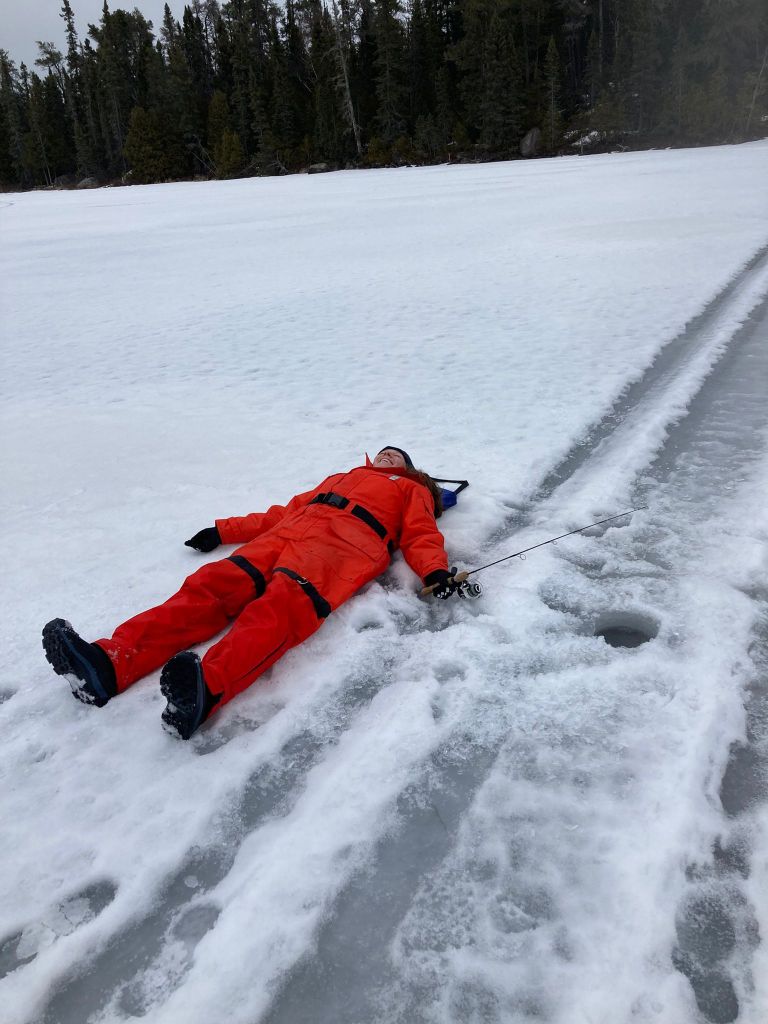
The second part of the trip was a little more challenging. The first two days of ice fishing for burbot were not very fruitful. We tried fishing at every time of day (evening, morning and afternoon), in every area of the lake (soo many auger holes…) but those pesky fish were no where to be found. Finally on the last day, there was a bite! The fish that came out the hole was not a burbot though, but a lake trout. But beggars can’t be choosers so we kindly asked the trout to throw up it’s lunch (lots of zooplankton and a minnow, yum!). A second lake trout was caught just minutes after the first. After emptying their bellies the trout were released back into the lake.


 The pELAstic Project